
Welcome to WordPress. This is your first post. Edit or delete it, then start blogging!
Lorem ipsum dolor sit amet, consectetuer adipiscing elit, sed diam nonummy nibh euismod tincidunt ut laoreet dolore magna aliquam erat volutpat.Lorem ipsum dolor sit amet, consectetuer adipiscing elit, sed diam nonummy nibh euismod tincidunt ut laoreet dolore magna aliquam erat volutpat.Lorem ipsum dolor sit amet, consectetuer adipiscing elit, sed diam nonummy nibh euismod tincidunt ut laoreet dolore magna aliquam erat volutpat.Lorem ipsum dolor sit amet, consectetuer adipiscing elit, sed diam nonummy nibh euismod tincidunt ut laoreet dolore magna aliquam erat volutpat.
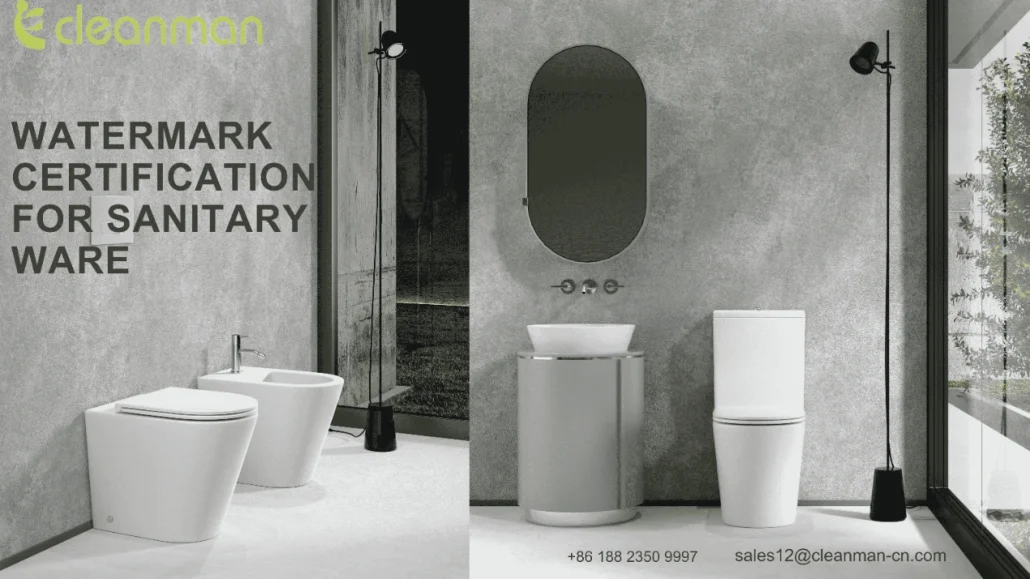
WaterMark Certification for Sanitary Ware: Australia Guide
WaterMark Certification for Sanitary Ware is one of the first issues you should check before importing toilets, bidets, basins, baths, or bathroom fittings into Australia. A product may look suitable and perform well in factory testing, but Australian plumbers may still be unable to install it if the required certification is missing.
At Cleanman, we often see buyers focus on the ceramic body while overlooking the cistern, flush valve, inlet valve, waste outlet, or bidet connection. WaterMark Certification for Sanitary Ware must therefore be checked against the complete product configuration, not only the main ceramic fixture.
This guide explains which bathroom products normally require certification, which fixtures are generally excluded, how WaterMark differs from WELS, and what the May 2026 lead-free rules mean for importers.
What Does WaterMark Certification Mean?
WaterMark is Australia’s mandatory certification scheme for specified plumbing and drainage products. It confirms that a listed product complies with the Plumbing Code of Australia, is fit for its intended use, and meets the relevant product standard.
Certification is issued by an approved WaterMark Conformity Assessment Body. The certificate normally identifies the certificate holder, brand, model number, applicable standard, product description, expiry date, and scope of use.
A logo printed on a carton is not enough. You should confirm that the exact model appears on a current certificate and that the certificate covers the complete configuration you plan to import. 
Which Products Need WaterMark Certification for Sanitary Ware?
WaterMark Certification for Sanitary Ware generally applies when a product forms a regulated part of a water supply, sanitary plumbing, or drainage installation. For toilet and bathroom projects, the following product groups commonly require certification:
- Water closet pans intended for use with cisterns or other flushing devices
- Toilet cisterns and dual-flush cisterns
- Flushing devices and flushing valves
- Cistern inlet valves and outlet valves
- Complete toilet suites, including matched pan and cistern combinations
- Bidets, bidettes, and regulated bidet douche seats
- Urinals and related flushing equipment
- Waste outlets, traps, connectors, and other regulated sanitary plumbing components
A ceramic toilet pan should not automatically be treated as exempt. Water closet pans are commonly assessed under AS 1172.1, while flushing devices and cistern valves are commonly assessed under AS 1172.2.
For a complete toilet suite, the pan, cistern, flush mechanism, inlet valve, and outlet valve must work as an approved combination. WaterMark Certification for Sanitary Ware should cover the exact matched models rather than unrelated parts collected from several suppliers.
Why Individual Component Certificates May Not Be Enough
A certificate for an inlet valve does not prove that the complete toilet suite is certified. In the same way, a certified pan does not automatically cover a different cistern or flush mechanism.
Before shipment, compare every product code on your purchase order with the model schedule attached to the WaterMark certificate. This simple check can prevent customs delays, rejected project submissions, relabelling costs, and stock that licensed plumbers cannot install.Check the pan, cistern, flushing system, valves, and product model as one complete compliance package.
Products Usually Excluded from WaterMark Certification for Sanitary Ware
Not every ceramic bathroom product needs WaterMark Certification for Sanitary Ware. The fixture bodies of the following products are generally listed as excluded products:
- Basins and washbasins
- Kitchen and laundry sinks
- Baths
- Shower bases
- Laundry troughs
- Vanity cabinets and bathroom furniture
However, “excluded” does not mean that every component supplied with the fixture is also excluded. A basin may not require WaterMark for its ceramic body, while its waste outlet, trap, flexible hose, mixer, or connection fitting may require separate certification.
This distinction matters when you buy a complete bathroom package. Ask the supplier to separate the fixture body from the regulated plumbing components on the product list and compliance file.
WaterMark Certification for Sanitary Ware and WELS
WaterMark Certification for Sanitary Ware and WELS serve different purposes. One does not replace the other.
- WaterMark confirms plumbing safety, product suitability, and compliance with the applicable plumbing standard.
- WELS measures water efficiency and controls the star rating, consumption information, registration number, and product labelling.
For regulated plumbing products, a valid WaterMark certificate is required before the model can be registered under WELS. You can review the official requirements on the Australian Government Water Rating WaterMark guidance page.
From 17 June 2022, newly registered dual-flush toilets must achieve at least a 3-star WELS rating. A 4-star model normally gives importers a stronger water-efficiency position for residential developments, retail ranges, and project specifications.
WaterMark Certification for Sanitary Ware should be checked together with the WELS registration. The brand name, model number, flush volume, product description, and registered supplier should match across the certificate, WELS database, packaging, quotation, and marketing material.
The May 2026 Lead-Free Requirement
From 1 May 2026, applicable copper-alloy plumbing products used in contact with drinking water must have a weighted average lead content of no more than 0.25%. Products within the rule may need the Lead Free WaterMark identification as well as standard WaterMark certification.
This requirement does not automatically apply to every product installed in a bathroom. Sanitary fixtures used for non-drinking purposes, including toilets and many cistern-related products, are generally excluded from the lead-free provision.
Related potable-water products may still be affected. Examples can include:
- Basin and kitchen mixers containing copper alloy
- Applicable flexible hose assemblies
- Backflow prevention devices
- Tempering and thermostatic mixing valves
- Drinking-water fittings, dispensers, and valves
Do not assume that a standard WaterMark certificate also proves lead-free compliance. Check whether the product is subject to the lead-free rule, look for the correct certification identification, and confirm the model schedule with the certificate holder.
Because plumbing rules are enforced through Australian states and territories, you should also confirm the current local adoption and installation requirements for the destination market.
Relevant Standards for Australian Sanitary Ware
The applicable standard depends on the product type and design. Common references for toilet and bidet projects include:
- AS 1172.1 for water closet pans
- AS 1172.2 for flushing devices and cistern inlet and outlet valves
- AS 1172.3 for bidets and bidettes
- WMTS-051 for applicable bidet douche seats
- AS/NZS 6400 for WELS water-efficiency rating and labelling
- AS/NZS 3500 for plumbing and drainage installation requirements
Standards and WaterMark schedules can be amended. The standard printed on an old test report may no longer be the current certification basis. WaterMark Certification for Sanitary Ware should always be supported by a valid certificate rather than a test report alone.
How to Verify WaterMark Certification for Sanitary Ware
Before placing a deposit, use the following process to verify WaterMark Certification for Sanitary Ware:
- Request the complete WaterMark certificate and attached model schedule.
- Check the certificate number, issue date, expiry date, and current status.
- Match the brand and model number with your quotation and purchase order.
- Read the product description and scope of use.
- Confirm that the pan, cistern, valves, and flushing system are approved as supplied.
- Check the separate WELS registration and star rating where required.
- Confirm lead-free compliance only for components that fall within the 2026 rule.
- Approve product labels, cartons, manuals, and online marketing before mass production.
You should also control component changes after certification. Replacing an approved inlet valve, flush valve, connector, or cistern with a cheaper alternative may move the delivered product outside the certificate scope.

How Cleanman Supports Australian Buyers
At Cleanman, we treat compliance as part of product development rather than a document collected at the end of production. When you source an Australian toilet range, we recommend confirming the target standard, flush volume, pan and cistern combination, valve selection, model code, and label format before the final sample is approved.
Our WaterMark and WELS 4-star rimless bathroom suite for Australian buyers shows how the certified model, flushing system, and water-efficiency information can be aligned for wholesalers, builders, and project suppliers.
For OEM projects, buyers should keep the certified configuration stable from testing through mass production. Any proposed change to the ceramic structure, flushing parts, valves, brand, or model identification should be reviewed before shipment.
Final Procurement Advice
Do not decide compliance from the product appearance, supplier claim, test report, or logo alone. Check the current certificate, complete model schedule, WELS registration, component list, and intended installation before you approve an order.
Correct WaterMark Certification for Sanitary Ware protects your Australian distribution plan, gives plumbers clear installation evidence, and reduces the risk of rejected projects or unsellable stock. When the paperwork and physical product match from the beginning, market entry becomes much more predictable.


